
The world’s first passenger tram wasn’t in Paris or Berlin but in Wales. Parliament passed the Mumbles Railway Act in 1804 and, just three years later in 1807, horse-drawn trams were already carrying passengers along the Swansea coast. From vision to rails on the ground in less time than it now takes Britain to secure planning for a single mile of track.
Today we lag behind our European neighbours. While 21 French cities have built new tramways since 2000, only a handful of UK cities, Manchester, Nottingham, Sheffield, Croydon, Birmingham, Blackpool, Edinburgh, have them. Leeds remains the largest city in Europe without any metro or tram at all. The result? Congested roads, low productivity, sprawling housing, and missed opportunities for growth.
It doesn’t have to be this way. Trams are proven to cut traffic, boost housing density and unlock regeneration. The reason we don’t build them is not geography or technology. It is the rules and red tape we have chosen. All of which can be fixed.
Why trams matter
Trams carry far more people than cars or buses using the same road space. They are clean, reliable, and popular: when Nottingham’s network opened, 30% of riders came straight from cars. Studies show drivers are six to eight times more likely to switch to trams than buses. In France, Tours’ tram removed 25,000 car trips a day.
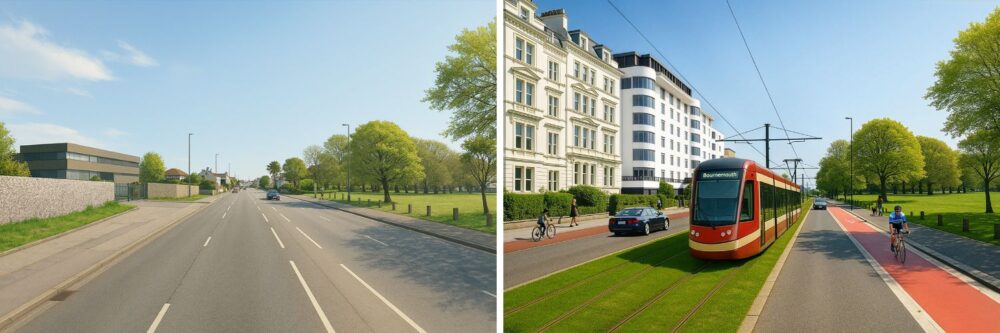
Trams reshape cities too. Croydon’s Tramlink spurred new flats and brought commuters back. Manchester’s Metrolink turned Salford Quays into MediaCityUK. In Bordeaux, trams transformed polluted boulevards into thriving civic streets. Land values rise, 20 per cent in Croydon, up to 15 per cent in Bordeaux, helping fund the network.
They also unlock housing. Tram-served sites can support twice the homes per hectare compared to car-oriented estates. In short: if we want more homes and more affordable places with better public spaces, trams are a proven answer.
So why are ours so expensive?
Building trams in Britain costs £87m per mile, more than double the European average of £42m. Manchester’s Second City Crossing hit £252m per mile. Compare that to Besançon and Angers in France at £29m per mile.
The reasons are institutional, not inevitable:
- Utility diversion mania. UK tram schemes are forced to dig up and move almost every pipe and cable by a 1990’s code of practice designed for older track technology. In Sheffield, a quarter of the project budget, £60m, went on utilities. French cities leave most in place. To make matters worse, UK rules force tram promoters to pay 5% of utility relocation costs, giving companies every incentive to “gold-plate” their demands.
- Byzantine approvals. New lines require a Transport and Works Act Order, dragging on for years and costing millions. A one-mile Birmingham extension needed four years and 52 documents. Environmental Impact Assessments are demanded for track on existing roads, even though it’s inherently environmental by moving people from cars to electric trams.
- No standardisation. Each UK project is bespoke, with unique track, stops, and vehicles. France slashed costs by using repeatable designs.
- Outdated operating law. Councils cannot easily run their own tram systems, even though many European cities operate municipal networks.
Four fixes to unleash a tram renaissance
- Empower cities and cut red tape. Permit Local authorities to operate tram lines under existing legislation. This is no different than what we now do for buses. Devolve TWAO approval to mayors and make this a specific, lighter touch TWAO for trams. Waive Environmental Impact Assessments (EIAs) for trams on existing roads or urban areas, like Spain did. Let local leaders sign off their own networks and spend their own money.
- Fix utilities. Update the code of practice (SI) of the New Roads and Streetworks Act 1991, so all utilities except old sewage pipes are left in place by default. Change the Street Works rules so utilities pay a bit more to move their own kit, as in France. Support Coventry’s shallow-track project nationwide which means most utilities are not even touched.
- Empower cities. Give councils funding tools like workplace parking levies and land value capture. Scrap the ban on municipal operators so cities can integrate trams with buses for the public good.
- Standardise and innovate. Create a DfT Light Rail Delivery Unit to set national tram standards, develop off-the-shelf designs, and encourage cities to procure vehicles together. Scale up Coventry’s modular track technology to cut costs further. Its built entirely in the UK so this will support local industry.
Time to Get Moving
This is not about nostalgia. It is about building an abundance of the housing, jobs and clean transport our cities desperately need. If we built trams at European prices, West Yorkshire’s £2.5bn tram budget could fund 60 miles of track, not 29.
The case is overwhelming: trams move more people, attract more riders, and shape better places than buses or roads alone. The obstacles are man-made. Change the rules, and we can unleash a tram revolution.
It’s time for trams